


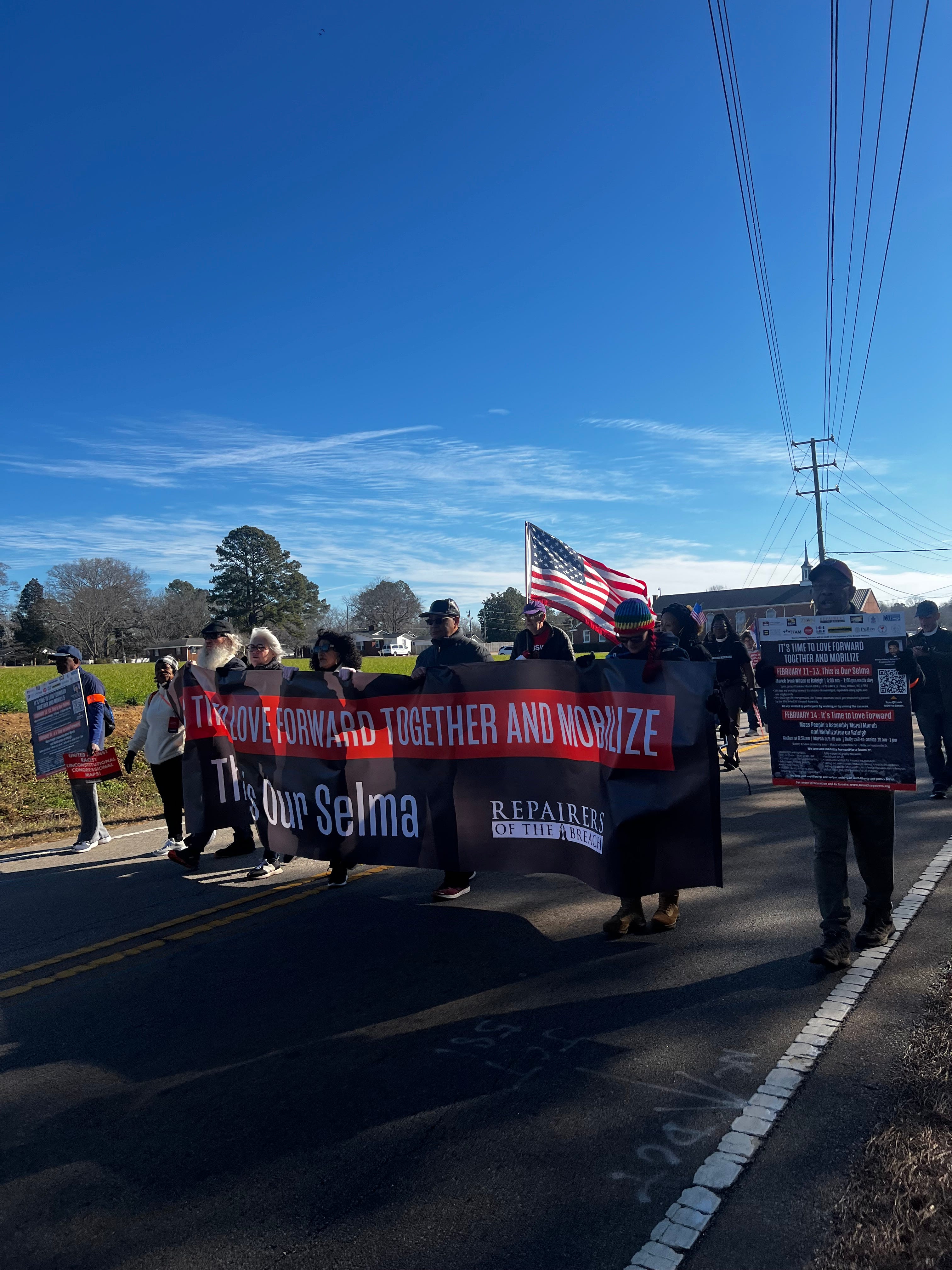
One of the truisms of covering civil rights activism is that, if marching is involved, it will be either unbearably hot or bitterly cold. The weather was the latter, back in February, when I joined demonstrators for a multi-day march across eastern North Carolina.
That stretch of the state, often overlooked in favor of more populous regions around Charlotte, Raleigh and Durham, is represented by Congressman Don Davis, a moderate Black Democrat.
But North Carolina Republicans — as part of a nationwide effort to target vulnerable Democratic seats — redrew Davis’ district, threatening one of the state’s few congressional districts anchored by Black voters. This, in turn, resulted in local efforts to mobilize Black voters in response.
“They see what’s at stake,” the Rev. William Barber, who helped lead the voter mobilization efforts, told me as we watched residents come out of their homes to meet the marchers.
Later that weekend, as we sat outside the North Carolina statehouse where the march concluded in a rally, former Republican operative Steve Schmidt predicted that the coming midterms would see a massive backlash to the Trump presidency. “There is a movement rising up of ordinary people.”
For Black voters across the South, the stakes were more immediate than the usual midterm referendum on an unpopular president. Republicans had spent months attempting to redraw the political maps in ways that diminished Black representation that had taken generations of struggle and bloodshed to obtain. The question was whether such an attack on Black political power would be mobilizing. By April, when thousands descended on Alabama — first in Selma, to march across the Edmund Pettus Bridge and then later at the statehouse — it was scorching hot. The rally, called “All Roads Lead South” sought to challenge decades of Democratic strategic thinking.
For years, national Democrats have treated much of the Deep South as electorally unwinnable.
Black activists and operatives have long argued that the problem was not a lack of persuadable voters, but a lack of sustained political investment — the kind that cannot begin six weeks before Election Day. In recent years, pollsters have also developed new and deeper understandings of how to mobilize young Black voters. Appeals to history alone (“Your ancestors died for your right to vote!”) no longer resonate as they once did. Instead, operatives and organizers across the country emphasized connecting the midterms to Black voters’ frustrations with the status quo and desire for change, and then layering atop that a civil rights framing.
The midterm election results suggest that these organizers were onto something.
‘Blacklash’
As expected, Tuesday’s midterm elections delivered a “blue tsunami,” with Democrats taking back control of both the House and the Senate. In some ways, this was to be expected during the midterm cycle, during which the sitting president’s party almost always loses some power, especially given the historic unpopularity of President Trump. Americans have seen federal agents deployed to their cities where they have dragged away, and in some cases killed, their neighbors. Even with that said, few could have predicted the totality of the Democratic wins — a statewide sweep in Texas, upset victories across North Carolina and Florida, major Senate wins in virtually every competitive race.
While we’re still awaiting more detailed analysis, it is already clear that Tuesday’s Democratic wave was powered by a broad coalition of voters furious about the state of the economy, the corruption and impunity of the Trump Administration, and the overall direction of the country.
But it is also clear that the ‘Blacklash’ did, in fact, materialize, especially across the South, where organizations and candidates — in some cases absent the support of the national Democratic party apparatus — have spent months recruiting candidates, registering voters, and building infrastructure.
“Trump has tried to neuter (Black voters). You know, he did all that reapportionment, which really infuriated them. And everybody knows that he’s turned the Justice Department into a political operation, not a justice operation,” former President Bill Clinton told Politico’s Jonathan Martin while stumping in Mississippi. “I think they really feel, the vulnerable people, doubly vulnerable because they don’t have the Congress, and because of all these decisions the Supreme Court made.”
While votes are still being counted in districts across the country, voter turnout efforts successfully protected a number of vulnerable Black incumbents, including Don Davis in North Carolina and Shomari Figures in Alabama.
Juliana Stratton’s win in Illinois means that, for the first time in history, three Black women will serve simultaneously in the Senate next term. Record Black turnout in parts of Texas and South Carolina helped flip crucial Senate seats.
Even in Florida, state Rep. Angie Nixon, a Black progressive who received little national Democratic establishment support, came within striking distance of defeating Republican Sen. Ashley Moody.
For much of American history, the governorship remained exclusively a white office. Before this week, just three Black Americans had ever been elected as governor. Now, five elected Black governors are poised to serve simultaneously, including Keisha Lance Bottoms, who with her victory in Georgia became the first Black woman elected governor in American history.
“I didn’t become Maryland’s first Black governor because the Democratic Party said ‘I think it’s time for us to put Wes Moore up in the seat.’ I had to run against the party,” Moore, who was re-elected easily last night, told the AP earlier this year. “I don’t think that the party is doing enough.”
A Mississippi Miracle?
The most remarkable result of the cycle may yet come in Mississippi, where Democrat Scott Colom remains locked in an extraordinarily close contest against Republican incumbent Sen. Cindy Hyde-Smith. In some counties, Colom is currently running more than 20 points ahead of Kamala Harris’ 2024 performance. If he ultimately prevails, he becomes the state’s first Black U.S. Senator since Reconstruction.
“We’re trending in counties that people thought we had no chance of competing in — and we’re winning them,” Colom told supporters who gathered in downtown Jackson last night.
Matthew Yglesias recently argued that Democrats too often compare contemporary political struggles to the civil rights movement, leading them to embrace tactics ill-suited to the fights at hand. And he has a point. But this election cycle featured battles that, in many places across the South, bore striking similarities to those of the 1960s. A nativist president rolled back Justice Department oversight of violent local police forces and cut health care and other federal assistance in ways that, for the average Black American, were felt in pocketbooks and at dinner tables. Meanwhile, his hand-picked Supreme Court targeted Black congressional representation.
If there was any place in the country where appeals to civil rights history might have particular resonance, and where sustained investment in difficult races had the potential to pay off if Democrats could commit to fielding serious candidates, it was Mississippi: which is the state that, by percentage, is the Blackest in the country.
It was the state where 15-year-old Emmett Till was abducted and lynched — a crime that mobilized Black citizens across the country, including both Rosa Parks and John Lewis. It was the home base of Fannie Lou Hamer, one of the most consequential voting rights organizers of the civil rights movement. It’s where, earlier this year, a 1-year-old Black boy named Kohan Wiley was shot and killed by a police officer after his mother was accused of stealing diapers from a Walmart. It’s where, 18-year-old Nolan Wells went missing over the July 4th holiday weekend and later was found dead in a case that, in Black America, was the biggest news story of the year.
As Albert Samaha wrote in a New York Magazine piece published this week:
…the questions surrounding what exactly happened to Wells on Horn Island have not gone away. The story ricocheted around social media, fueled by suspicions that his death echoed Mississippi’s history of racist violence. It sparked conversations about the safety of Black people in predominantly white spaces. The last known photo of Wells showed him sitting on a boat next to three white friends. Witnesses on the island said they last saw Wells flirting with a white woman. Ben Crump, the prominent civil-rights lawyer, signed on to represent Wells’s family. Al Sharpton spoke at his funeral. Colin Kaepernick paid for an independent autopsy. Terrell Owens and Tyler Perry contributed to the $125,000 reward for information leading to an arrest and conviction in connection with Wells’s death.
Mississippi was also home to Medgar Evers, a U.S. Army veteran and NAACP field secretary whose work in organizing Black voters made him one of the civil rights movement’s most consequential leaders before a white supremacist murdered him in 1963.
This history gave the contemporary fight over political representation a particular resonance.
Here was the Colom campaign’s closing message:
As of this writing, Colom leads the vote count in a race that, for the moment, is too close to call.
Whether Scott Colom ultimately wins or loses, the closeness of this race should itself be enough to challenge decades of conventional wisdom about what is possible across the South.
It should raise new questions about what investments Democrats could and should have made in states like Louisiana and Florida. Perhaps sustained effort, credible candidates and organizing that begins months — not weeks or days — before ballots are cast, can help them compete in places that were long ago written off.
Back in February, as we marched through the North Carolina cold, the people who came out to greet us had no guarantee of a victory last night. In fact, it felt more likely than not that Don Davis would lose his congressional seat.
They came out anyway.