


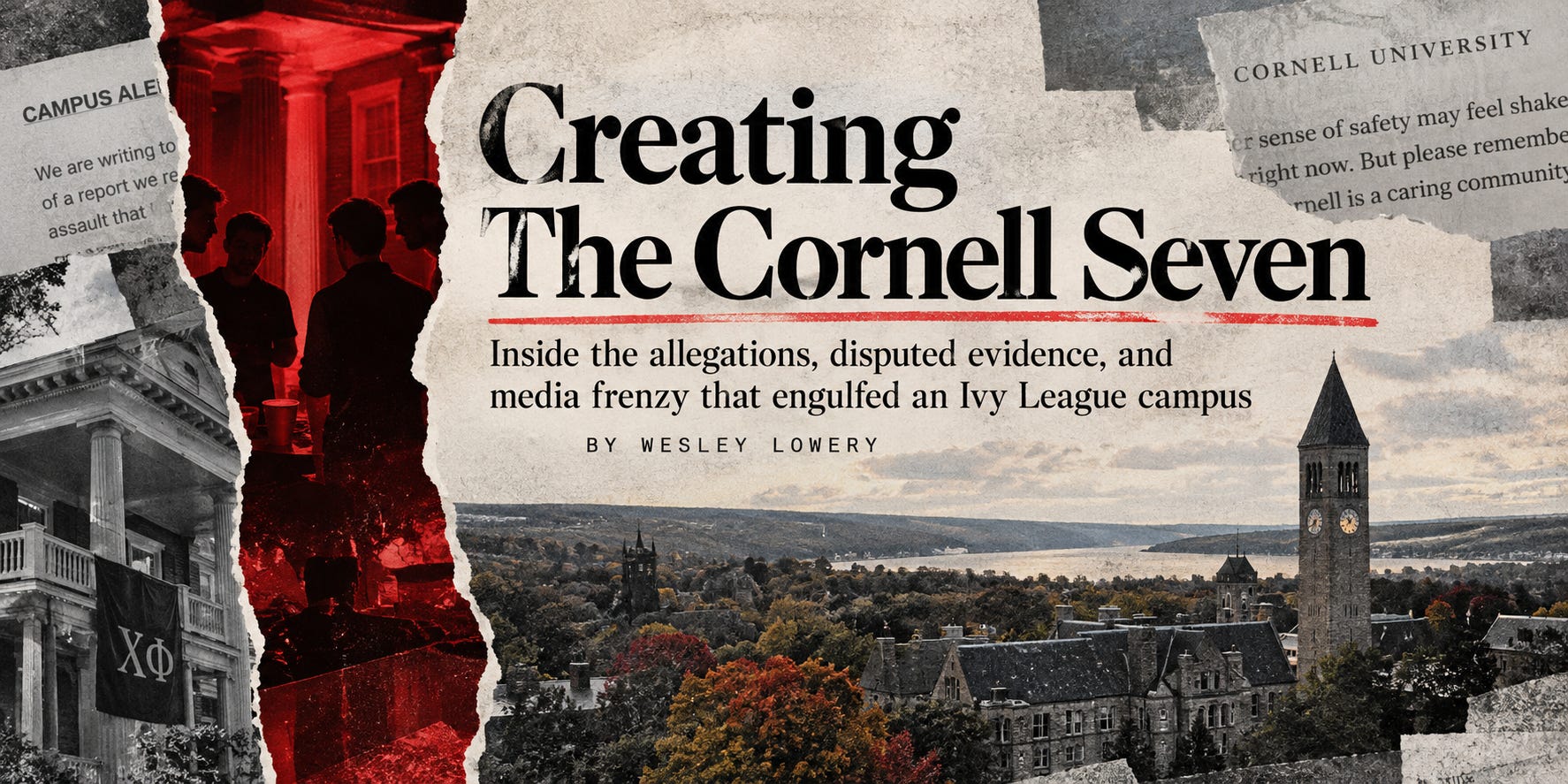
On Friday, November 8, 2024, an emergency alert went out at Cornell University, a 26,500-student Ivy League school in Ithaca, New York. A 20-year-old member of the Tri-Delta sorority had told the university that, three weeks earlier, she’d been coerced into consuming ketamine and marijuana and sexually assaulted “by multiple males.”
The alert said the alleged crime took place at a frat house in the 100 block of Edgemoor Lane. Two fraternities are on that block. The president of one said he had no idea about the allegations. The other frat, Chi Phi, at 107 Edgemoor, did not publicly respond. All Greek Life activities were cancelled for the coming weekend. Some students threw eggs at the Chi Phi house.
“Our sense of safety may feel shaken right now,” the university’s student affairs vice president wrote to campus the following Monday. “Please remember that Cornell is a caring community.”
On Thursday, Nov. 14, the woman at the center of the case, a second-year student in the hotel administration program, met with university investigators. “(She) recounted what she could remember. She also reported rumors of a group Snapchat circulating among the fraternity members,” a school official later wrote.
Then, on Friday, Nov. 15, she met with investigators at the Cornell University Police Department. “Once she was emotionally ready, she went to the University police and bravely shared what had occurred,” her attorney Thomas Giuffra later said. “She believed that she was the victim of a crime.”
The criminal process moved quickly. The woman signed a six-page statement that local prosecutors decided contained too many contradictions and inconsistencies to support criminal charges. The woman describes feeling used and disrespected by the men — all fraternity members — and at some points pressured to escalate sexual activity. However, on multiple occasions, her account included admissions that she’d verbally consented to various sex acts and voluntarily performed them.
While verbal agreement to sexual activity does not necessarily establish legally valid consent, particularly when substantial intoxication is involved, such statements can complicate a criminal prosecution in cases in which someone believes themselves victim of a crime. Prosecutors would still have to prove beyond a reasonable doubt that the elements of a particular offense had been satisfied, including any applicable requirements (which can vary by state) concerning the accused person’s awareness of the complainant’s incapacity.
“Each time (she) asked to stop the sexual contact, the contact stopped,” Tompkins County District Attorney Matthew Van Houten explained of his decision not to prosecute. (He later said he never saw the woman’s full interview transcript, just the signed statement).
Cornell’s Title IX process, however, operated under a different standard of proof and a broader definition of “sexual assault” than the criminal-legal system.
The university probe stretched for months. Investigators conducted 31 interviews in the months of December and January and then another 17 in February — including a followup with the accuser. All told, the Title IX investigation produced more than 5,000 pages of documents, including 1,700 pages of hearing transcripts alone.
Ultimately, in August 2025, Cornell’s disciplinary process concluded that the woman was too intoxicated to affirmatively consent that night, expelled two men, banned a third (who by then had graduated) from campus, and imposed multi-semester suspensions on two others.
Those university findings — reached under university disciplinary standards, rather than the criminal standard of proof beyond a reasonable doubt — did not establish that all seven accused students had participated in a sexual assault. At least two of the accused men, the process concluded, could not be proven to have touched the woman at all.

In mid-September of this year, the case burst into the national consciousness when the woman filed a lawsuit against Cornell, the fraternity, its president, her own sorority, and seven men who she interacted with inside the Chi Phi house.
The suit’s allegations — that all seven men had drugged her and then spent seven hours conducting a “gang rape,” for which Cornell then assigned them to write essays — were immediately amplified by The Cornell Sun, a campus paper that had been given a heads up the suit was coming, and soon, having gone viral, had spread across the country and globe.
The weeks since have seen Cornell thrust into crisis as the incident has become the nation’s most contentious college sexual assault case in a decade. Online activists took to tracking down any and all information about the accused. The men — now known collectively as “The Cornell Seven” — were no longer humans. They were now symbols of either, depending on your politics, the intractable nature of misogynistic sexual violence that is allowed to persist with impunity on American college campuses or of a hysterical culture void of due process and willing to immediately condemn men accused of so-called “sexual misconduct.”
Such ideological wars existed far before this case and will continue long after it is concluded. The real world, however, is rarely so black-and-white. In fact, it is possible that — one might argue the evidence reveals that — both sides are at least partially correct.
Contained in the accounts of these inebriated undergraduates are clear examples of young men behaving brutishly and inconsiderately (some might even say monstrously) as it relates to their duty of care for another person. The available evidence, however, does not support the depiction of a single, continuous seven-hour attack carried out by seven men. The available portions of Cornell’s disciplinary proceedings and punishments distinguished sharply between the conduct of individual men. It suggests the possibility that some of the seven behaved callously, even reprehensibly, but did not commit the violent crimes subsequently attributed to them in the lawsuit, for which they were promptly convicted in the court of public opinion.
“We have a problem of inadequate language…Before we can even effectively talk about this we need better language,” said education consultant Hanna Stotland, who has worked with more than 300 families of students facing discipline under Title IX after being accused of “sexual assault,” cases she says range from unwanted hugs to gang rapes. For a time last year Stotland worked with one of the accused men in this case. She declined to tell me which.
“There are lots and lots of areas where we have different names for the same types of wrongdoing at different levels of severity, and different levels of consequences for the perpetrators — as there should be,” she said, adding that she is angry with colleagues who quickly amplified the most incendiary version of the allegations. “People…should think for one second before publicly announcing that ‘Joe Schmoe — and here is his picture — is a rapist, when I have no inside information about the case and have never met Joe Schmoe.’”
What follows is an account of the case drawn from the spotty, often conflicting memories included in court filings, police documents, and Title IX records as well as new interviews with some of those connected to the case as well as other subject-matter experts. Considered together, they paint the clearest picture yet of what is known to have occurred inside the Chi Phi fraternity house on an inebriated night in October 2024 as well as in the two years since, including some details which have not previously been reported.
The facts now available paint a picture far different than that laid out in the initial “Jane Doe” lawsuit and the wave of media coverage that immediately followed it: allowing us to more fully consider context within accounts provided by the accused — the side of the story, by design, absent from the lawsuit and largely missing from most initial press coverage.
There remains much we don’t know. Cornell’s handling of the case is currently being reviewed by Sally Yates, a deputy attorney general under President Obama, while New York Attorney General Letitia James is probing the actions of local police and prosecutors. It remains possible — perhaps likely — such reviews will identify faults in the Title IX and criminal processes or surface new details that further alter our understanding of what happened that night.
Now 22 years old, the woman known in the court filings as “Jane Doe” has returned to her parents’ home in another state where, according to her attorneys, she has faced harassment and threats. Within days of her suit being filed, she’d been publicly named by various social media users. “My assailants threatened my safety and well being on numerous occasions,” the accuser, who has since dropped out of Cornell, is quoted as saying in one court filing. “Especially in plying me with copious amounts of drugs without regard for the consequences.”

The then-20-year-old woman arrived at the Chi Phi house, which was hosting a Hawaii-themed party, at the invitation of sophomore Matthew Ingalls. She has said she wanted to date Ingalls, who had her in “an emotional chokehold” and that she “would have done anything to please (him).”
The woman had already been drinking when she arrived at the fraternity that night and would later say that she had barely eaten that day. In general, the woman, who is 5’10 and a weightlifter, said she had been keeping her calorie count low because at the time she was cutting pounds. It was possible, she told police, that all she’d eaten that day was some chicken and rice after her afternoon workout.
After a change in plans meant she was not going to have to be a sober monitor for that night’s sorority party, she began binge drinking — sips of friends’ mixed drinks and, she estimated, six shots worth of Tito’s vodka chugged straight from the bottle — in an attempt to catch up with sorority members who’d started boozing half an hour before her.
It had been a difficult day. Her car had been broken into and her wallet stolen. Then, when it came time to head to the party, fellow sorority members left her behind. Around 8:30 p.m. she boarded an Uber along with the “house mom” and arrived at Moonie’s Bar and Nightclub, where she said she purchased a mixed drink — a Sex on the Beach — by concealing the under-21 marking on her hand. She and some others made their way to another bar, Lot 10. Then, the woman walked alone to the Chi Phi fraternity house about a mile away.
It is unclear exactly how inebriated she was upon her arrival, which she believes was sometime between 10:30 p.m. and 11 p.m. A fraternity brother who let her into the house told investigators she appeared “completely sober.” Her lawyer has said she was “visibly intoxicated” and “consumed 10 standard drinks within the past three hours.” When she first spoke with police the woman said she would have gauged herself as a “5 out of 10” in terms of drunkenness when she got to Chi Phi. In a phone conversation later, which the woman and her friends recorded, Ingalls recalled her telling him that she was sober when she arrived that night (which she disputed).
Once inside the fraternity house, Ingalls handed her a can of beer. The woman told police she remembered opening it herself with her teeth. The two then made their way to the living room, where for a while they danced suggestively. When Ingalls asked her if she was interested in having a threesome, the woman agreed and they went upstairs.
They proceeded to the “alumni room,” a hangout area with a loveseat and chair said to have been popular with sophomore members of the frat, especially after parties. The room doubled as the assigned bedroom for three men, including a sophomore from South Florida named Jonathan Newell, then-19, who the woman had hooked up with once previously. He would tell Title IX investigators he was already stumbling drunk when Ingalls recruited him to the threesome.
The woman recalled being “excited” upon hearing Newell would be their third.
“I thought (two men) wanting to have a threesome meant they were gay which would have meant that they were part of my community as I am bisexual,” she later told police. “I believe I said something like ‘I didn’t know you all were fruity.’”
That was not the style of threesome the men had in mind.
All three drank more and smoked marijuana. At some point, one of the men produced a baggie of Ketamine — a dissociative anesthetic increasingly used as a party drug — which they snorted off of a key. The woman told investigators she couldn’t remember which man provided the drugs or other details from whenever she first consumed it. Cornell investigators did not interpret that memory gap, by itself, as evidence that she had unknowingly been given the drug. “The lights were on but no one was home,” the woman later said about the nature of her intoxication. “You look like an operating human being,” she recounted. “You don’t look dead or asleep necessarily.”
Ingalls and Newell alternated receiving oral sex from her while the other penetrated her from behind. At one point Newell slapped her ass while having sex with her. “One hit in particular sent a sharp pain through me which caused me to turn around and say ‘Damn!’” she later told police. (The Associated Press would render this act as: “one of the men hit her during the attack.”)
All involved described the initial threesome as consensual. After “some minutes” — one of the men estimated about 10 — the sex stopped. Ingalls was falling asleep and could not stay erect. As he lay down, Newell began to dry heave and proclaim “I’m going to die.” The woman worked to convince Newell, still naked from the waist down, to throw up, while continuing to make out with him.
According to the woman, around 1 a.m. there was a knock on the door and a third man emerged. That man was Gillio Lopes, a 19-year-old fraternity member whose bed was in the alumni room and who has said he’d had a few drinks that night but retained a clear memory of what happened. He has said he did not believe the woman was significantly impaired during their interactions.
In his version of the story, as provided by him to Title IX investigators (and first reported by the New York Times) and later in media interviews by his attorney, Lopes did not knock, rather opened the door to his bedroom himself. He said he paused when he saw the woman and Newell naked on the couch, but then, he said, they invited him in and the woman began kissing him.
Before long, the woman, Newell and Lopes had all climbed into the bed where Ingalls was sleeping and engaged in a threesome next to him. “I don’t remember much of this threesome,” the woman would tell police, describing herself, at this point in the night, as “pretty incapacitated,” although it is unclear precisely what she meant by the term.
The woman told police that around that time she had heard the two of the men discussing Lopes “having a turn” being the one to penetrate her, which ultimately did not happen.
“I realized that the threesomes I had taken part in this night were not about each person getting their own gratification out of it, but more so about (the men) using me without caring about what I was getting out of the situation,” she said later. “This made me feel really used in the moment.”
Ingalls eventually woke up and requested to join, but that plan was rejected. The woman told police she immediately said no; some of the men would say there was a brief attempt but the act was too logistically complicated. At this point, Lopes left the room and went to McDonald’s.
He told the investigators that the threesome he’d participated in later felt dirty and beneath him. Lopes told investigators the woman suggested he have sex with her instead of just receiving oral sex — and that he rejected her attempt to escalate things. The Title IX process ultimately found Lopes responsible for sexual assault, concluding that the woman had been too intoxicated to consent to giving him oral sex. He was suspended for three semesters.
“All of the testimony contradicts the current story being peddled, the current narrative,” Andrew Miltenberg, a prominent Title IX attorney representing Lopes, has said of the description of his client as having participated in a “drugging” and “gang rape.”

The next few hours were, by all accounts, a bit of a blur.
At 1:42 a.m., Newell sent a message to the Snapchat thread where fraternity members often boasted and joked about drunken hijinks and sexual exploits in messages set to disappear after they are viewed. “Free pussy in alum, (pull up),” he wrote. Newell would later tell Cornell investigators that, due to his level of inebriation, he had no recollection of sending this message.
The message — later included in the Jane Doe lawsuit but which her attorney has said she did not see a copy of until sometime during the Title IX process — prompted a number of responses both in the chat, and in real life. Ultimately at least four additional men came to the alumni room. Among them were fraternity members Diego Sarabia, a senior, and Winston Lee, a sophomore. “They weren’t slurring their speech, they seemed perfectly normal,” Lee told investigators of the state they discovered Newell, Ingalls and the woman in when he arrived.
When the new men entered, the woman told police, she ran naked across the room from one bed to another where she placed her body beneath the covers next to Newell and inadvertently leaving her phone behind. “The night really becomes a blur for me at that point,” the woman said.
The woman would tell police that Sarabia, who was either 21 or 20 at the time, was crude and aggressive, making a rude remark to her that caused her to sit up in the bed, accidentally exposing her chest to all of the men. “(Diego) apologized and grabbed my face and started kissing me,” the woman recalled. She said she backed away to stop the kiss.
It remains unclear how Sarabia fully described his interactions with the woman that night, although he has consistently maintained he never had sex with her. “As far as (Diego) goes, this is essentially a lawsuit about an allegedly forced kiss,” his attorneys wrote in a recent court filing. “(Jane Doe) has filed a sensational complaint that repeatedly concludes (Diego) is a rapist, but her alleged facts, even if accepted as true, describe something entirely different.”
At one point, the woman said, as she and Sarabia continued to argue, she jumped up from the bed and struck a menacing pose, before returning to being under the covers after realizing she was posing naked in front of all of the men.
Later, when Newell got out of the bed , everyone began teasing him about his nakedness. Newell asked the woman if she wanted to do more drugs, and she snorted some off his penis. After being asked, the woman agreed to allow the men to do lines of ketamine off of her “perfect body,” which she had just displayed for them.
“I remember lying down and covering up my face,” she recalled. “I did put my hands over my face at that point.”
At some point, the woman told police, “two guys named Scott” came into the room.
“They felt more like voyeurs than anything in the situation,” she said.
Both of the Scotts consistently, and insistently, denied ever seeing the woman naked, touching her in any way, or consuming drugs that night — both said they had left the room prior to any drug or sexual activity resuming. The woman, they said, was at all times coherent and under the covers in an unlocked common room where no sexual activity seemed to be taking place.
“I was not found responsible by Cornell for any of the accusations involving sexual activity and drug use for which others received serious consequences,” Scott Norris, of Canandaigua, New York, told his local newspaper, acknowledging that he “thoughtlessly engaged in Snapchat and briefly stopped in the room where misconduct happened but not when it happened.”
The other, Scott Kretzschmar, a sophomore from southeast Michigan, would later say that they were already on their way to the alumni room when someone told them that there was a woman in there.
“By no means were we going to get free pussy…We were just going to see if everything was OK,” he told Cornell investigators, claiming that he and Norris were not in the room for more than five minutes, that he directly asked the woman if she was alright and he remembered her laughing at him about the fact that he and Norris were both named Scott.
Among the key narratives to spring from the Jane Doe lawsuit is that none of the fraternity brothers who saw the Snapchat messages attempted to intervene. Yet Kretzschmar has claimed, consistently, that the only reason he is even implicated in this case is because he did precisely that.
“I (am) sorry if maybe it wasn’t consensual, and she was victimized, I (am) sorry for not stopping it,” Kretzschmar said during the hearings. He maintains that had he sensed something amiss he would have intervened. “I’m sorry I couldn’t tell if she was under the influence.”
As for his own participation in the Snapchat conversation — in which he claimed to have a firsthand point of view of what was going on, and implying there was some type of group sex currently happening — Kretzschmar told investigators it was both a joke and a lie. He claimed he had posted it before having even entered the room. “Nobody would be proud of words that can be construed as really ugly, nasty things, but we can also recognize that saying things and typing immature things are not the same as committing sex crimes,” Jeremy Saland, Kretzschmar’s attorney, has said.
While the woman accused both Scotts of consuming ketamine off of her body — a contention supported by one other person who was in the room — two others present testified they did not. Both men submitted drug-test results to Cornell, which they cited as evidence supporting their denials of any drug use that night. Ultimately, the men were punished by the university only for having entered the room following the initial Snapchat messages.
As part of the Title IX hearing, the woman was cross-examined by Kretzschmar’s attorney, which stretched across two days and resulted in 40 pages of transcripts. She was asked if, were it true that Kretzschmar did not do drugs off of her, see her naked, or otherwise touch her, it would change her assessment of his role in and culpability for the night.
“(Kretzschmar) read in a group chat about free pussy upstairs and decided that he wanted to participate in whatever was going on,” she responded. “I don’t view him as any better of a man.”

As the night gave way to early morning, Lopes returned to the frat house, went up to the alumni room, and kicked everybody out so he could go to bed.
“(He) said something like ‘Ok we’re shutting down whatever the fuck this is,’” the woman would tell police. “The group of men all began to scatter.”
Ultimately, the woman left the room with Ingalls and Lee and went to another part of the fraternity house. When they arrived there, the woman has said, Ingalls proposed they do more drugs and continue having sex, requesting “a redemption for passing out earlier in the night.” At this point, the woman’s lawsuit claims she was “completely incapacitated.” She told police, however, that she was lucid and speaking, though said she was drunker then she had ever been before: an “8 out of 10.”
Lee told investigators that he remembered telling the woman “if you’re uncomfortable and you don’t want to do this, that’s perfectly ok,” to which he said the woman replied: “No, it’s fine. We’re all consenting adults here.” She would tell police she remembers the men repeatedly asking her until she agreed. The three of them had sex until around 5:45 a.m., when the woman announced she was too tired to continue. At that point, she told police, both men ceased sexual activity and she and Ingalls went to bed. One of the men drove her home around 10 a.m. the next day.
In recent weeks, the Times and TMZ have published text message exchanges between the woman and several of the men from the following days, as word spread across campus. On the following Monday night, Newell apologized, saying his memory of the night was fuzzy and that he’d been shutting down any rumors that he was hearing. “I really appreciate this text. My memories super clouded too,” the woman responded. She told Newell that some sorority members were spreading malicious gossip but reiterating that their threesomes had been consensual. “At the end of the day (none) of the sexual stuff was illegal and honestly I really liked being with (you and Matt)” she wrote.
“Anything anyone has to say about the gangbang is out of their jurisdiction,” she said before recalling snorting ketamine off his penis. “Our body our choice.”
Newell responded: “I don’t remember any of this happening…Had I been less fucked up and even somewhat aware of the situation and how out of hand it got I would’ve shut it down the second guys started walking in the room.”
The woman would later tell investigators that gossip among other members of Greek Life framed the incident as an assault, which she said was the first time she considered it such. Within days, the woman was texting Ingalls declaring that her life was being ruined by the rumors about what had happened and accusing him of lying. Soon after she texted Newell to say she no longer considered the sex consensual. A few days later she requested a rape kit.
When Cornell launched a new sexual assault task force a few months later, some students decried that decision. “Those who would often commit the sexual assault will most likely not be the ones attending the voluntary and optional sexual-assault workshops,” editor of the Cornell Sun, which claims to be America’s oldest independent campus paper, later explained. “Sexual misconduct cannot be solved in the same way that we try to attempt to solve plagiarism.”
In January 2026, a 22-year-old computer science and philosophy student named Sophia Dasser was named editor-in-chief of The Cornell Sun.
She had previously served as opinion editor, and told the New York Times that soon after her promotion she got an excited call from one of their reporters who was, at the time, studying abroad in Australia. “Sophia, I’m working on this story — I want it to be a focus of The Sun,” pleaded Cereese Qusba, then midway through her third year at Cornell.
Qusba had previously served as The Sun’s news editor and, by the time she took on this story, had written about potholes and common council races. She was also a member of Tri-Delta: the same sorority as the woman at the center of the case.
“I wanted to find out where the defendants were, what happened to the Title IX proceedings, what happened to a criminal investigation,” Qusba later told CNN. After connecting with the accuser and her attorneys, Qusba was informed a civil lawsuit was forthcoming. “It was a very small circle of people who knew.” Qusba said. “I had to be prepared to write that story.”
The lawsuit was, for the campus paper, unquestionably newsworthy. Yet there is a difference between reporting the allegations within a civil complaint and presenting those allegations in a manner that leaves readers with the impression the underlying facts have already been established.
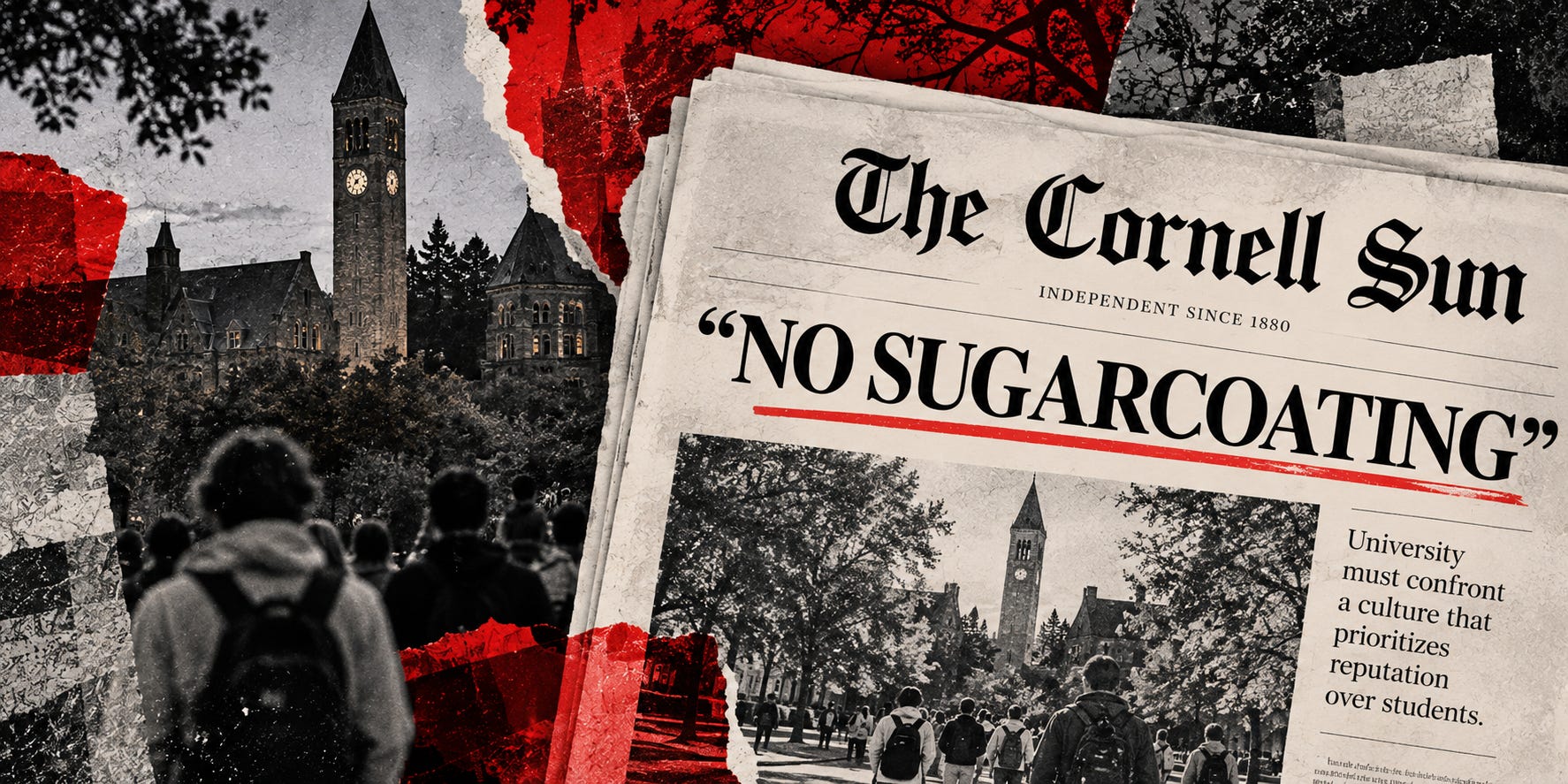
On Friday, Sept. 18, 2026, at 11:03 p.m., The Sun published Qusba’s 1,075-word piece. “There was no sugarcoating,” she would later explain.
The piece did not include any of what she said she had set out to get: new details about what had happened during the Title IX and police investigations and information about what happened since to the woman and the men who she’d accused. Instead, it provided a gruesome, horrifying account of the alleged assault that was drawn solely from the Jane Doe lawsuit. An editor’s note warned the piece contained allegations of “drugging.” The opening line described the accusations as “an alleged gang rape” — a term the piece did not define. “Details were included even if they were graphic or uncomfortable,” Qusba later said, adding that her news article “made a really big statement.”
The article named all seven of the accused men — as well as the fraternity president, who had not previously been implicated in any wrongdoing and has since been removed from the case by the judge, who noted he was not fraternity president at the time of the incident. The Sun article initially included no mention of whether its journalists had made any efforts to reach the accused men, their families, or their attorneys for comment prior to publication. It is unclear what, if any, obligation the student journalists believed they had to the men accused in the pages of their paper of extraordinarily serious sexual offenses. (Neither Dasser nor Qusba responded to requests for further comment).
“This was deliberate and planned. Reporters from the Cornell Sun, which has reported on this case from the outset, disclosed to CNN that they coordinated with Jane Doe and her attorneys before this lawsuit was filed,” James C. Knox, Sarabia’s Albany-based attorney wrote in one court filing. “In short, plaintiff’s attorney’s media blast was not merely an organic result of inquiry, but has been an orchestrated campaign from the outset.”

Decades of best practice dictate journalists exercise extreme caution in repeating framing devices and details offered by accusers in such incidents. In their review of Rolling Stone’s botched 2014 investigation into an alleged University of Virginia gang rape, a panel of journalists concluded one of the magazine’s greatest errors was refusing to fully interrogate the claims of the accuser before repeating them publicly. “The failure encompassed reporting, editing, editorial supervision and fact-checking,” the reviewers wrote. “The magazine set aside or rationalized as unnecessary essential practices of reporting that, if pursued, would have led the magazine’s editors to reconsider...The published story glossed over the gaps in the magazine’s reporting.”
Campus media outlets often face difficult, messy calculations. College campuses are small communities where those doing the writing and reporting often know, interact with, date, and know from other organizations, the students, professors and community members who they write about. Navigating the ethical complications of such closeness is difficult even for seasoned professional journalists, and involves any number of subjective decisions that, in so much as there is a binary, are easy to get wrong. In some cases, campus paper staff members cover organizations in which their own colleagues are participants and events in which fellow staff members are at times the newsmakers. For example, at a public meeting hosted by Cornell’s student government on Oct. 3, Sophia Riley Sim, a senior writer in The Sun’s news department, spoke on behalf of the campus ACLU chapter. (She does not appear to have contributed to the paper’s coverage of the case).
“The greatest failure was Cornell not protecting Jane Doe and allowing perpetrators to remain on our campus,” Riley Sim said. “But Cornell has also failed our community through its lack of accountability, transparency and failure to address the state of the Cornell student body.”
Nor is the choice to name a student or students accused of wrongdoing — including allegations of sexual violence — a situation unique to this case. It is, however, unclear what, if any, policies the paper has regarding coverage of serious criminal allegations. It is unclear if the student journalists at The Sun consulted any professors or professionals.
“Lacking experience, but full of piss and vinegar, I ran a story, it was my decision, on the top of the front of the newspaper, with the football player’s picture, and his name,” sports journalist Jeff Pearlman, a bestselling author and journalism professor, recalled in an online video, of his choice years ago as a campus newspaper editor to name the accused in a sexual assault case.
“It turns out later the woman took back the charges or didn’t pursue the case. The football player dropped out (of college) in shame,” Pearlman continued. “If any of these seven kids (at Cornell) are innocent of what they are accused of, or weren’t involved, or fill in the blank, their names are forever, ever attached to this…I am uncomfortable with their names being out there as having been accused of something…It is possible that one of these guys wasn’t involved.”
At Cornell, the paper went further than just printing the names. After breaking the news of the lawsuit, The Sun quickly published a front-page editorial naming and shaming them. “We called up our lawyer, and we were like, ‘Can we do this?’” explained Dasser, who said she first proposed the idea while eating cake as Sun staff celebrated the paper’s 146th anniversary. The resulting front-page editorial carried the headline: “Cornell Won’t, We Will.” In its opening line, it again named the accused. “This is not a dark chapter in Cornell’s history, it’s a morbid pattern,” the editorial declared. It concluded by listing the men’s names a second time, in bold. “We know who you are and we refuse to let you benefit from this University’s concealment.”
Within days, the names and faces of the accused men were circulating online internationally. “(Dasser) told me that this is a way of modeling the transparency that she is not seeing from the administration,” explained New York Times reporter Emma Goldberg. “That being said,” Goldberg continued. “In walking around campus and talking with students…Some students feel like they don’t want to rush to judgment because they want more information.”
The Times, for its part, took that approach. Its coverage came only after local prosecutors announced they were reexamining the case, and their work was supplemented by a trove of hundreds of pages of documents from the Title IX and police investigations which provided context, including the perspective of the accused. “We wanted to approach it with an abundance of caution,” Times metro editor Nikita Stewart has said. “The men were not public figures and not charged. There was a lot to untangle. That gave us pause.”
But no matter the decisions made by professional media outlets, once the names and other decontextualized pieces of evidence were out there, they were out there. Men who shared the same or similar names as the accused reported facing threats and harassment. A website posted an outdated list of fraternity members -- implying those listed had been included in the group chat messages. In interviews with The New Yorker two of those men, who had been completely uninvolved in this incident, recounted being targeted by online vigilantes deputized by the Jane Doe lawsuit.
“Our society has developed procedures and legal mechanisms over the course of centuries to ensure justice and due process are afforded to all. When certain actors decide to work outside those robust and developed frameworks, innocent people often get hurt. That is precisely what has happened here,” Judge Phaedra F. Perry wrote in a court filing earlier this month. “Everyone involved, be it the public, parties, or their attorneys, needs to do their part in bringing the temperature down before someone gets hurt.”
Wesley Lowery is a journalist who covers issues of justice. He has twice contributed to reporting teams awarded the Pulitzer Prize. He can be reached at wesley@wesleyjlowery.com
